
Back with a BAM: My Not-a-Review of A Streetcar Named Desire

Paul Mescal and the cast of A Streetcar Named Desire at BAM, Spring 2025. Photo by Julieta Cervantes.
[There exists a] crying, almost screaming, need of a great worldwide human effort to know ourselves and each other a great deal better, well enough to concede that no man has a monopoly on right or virtue any more than any man has a corner on duplicity and evil and so forth. If people, and races and nations, would start with that self-manifest truth, then I think that the world could sidestep the sort of corruption which I have involuntarily chosen as the basic, allegorical theme of my plays as a whole.
—From an interview Tennessee Williams conducted with himself, first published in the London Observer, April 7, 1957, ten years after A Streetcar Named Desire premiered
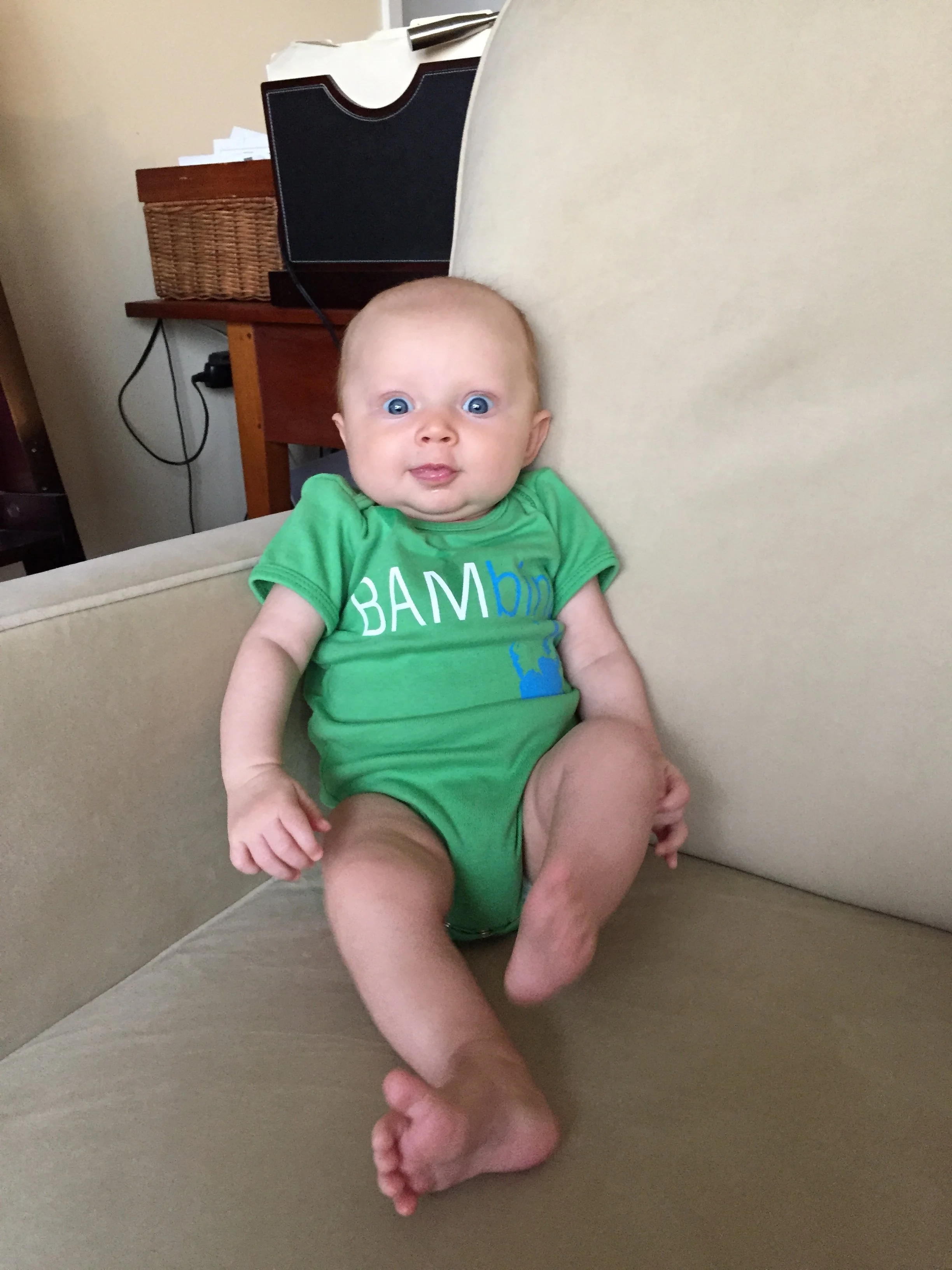
Our daughter Cordelia, now 10, in a onesie gifted by none other than Joe Melillo, BAM’s visionary executive producer from 1999 to 2018.
My first visit to BAM in many years was for my maiden voyage on AStreetcar Named Desire. The London-born Almeida Theatre Production directed by Rebecca Fraknell recently finished a short sold-out run (March 6-April 9) at BAM’s Harvey Theater following its original stint in 2023. The most recent splash in the show’s well-documented production history since Elia Kazan’s Brando-Tandy 1947 debut, it reaffirms Streetcar’s status as a masterpiece of lyricism and drama that takes on no less than the entire human condition. Blanche wordlessly says it all in one of Williams’ last stage directions, “[she wears] a look of sorrowful perplexity as though all human experience shows on her face.”
BAM invited me to review the production, but it didn’t need my review. Many Williams experts have written extensively about the London and Brooklyn runs, dramaphiles who know the play inside and out. What I have to add might be interesting in part because I had no precedent. My knowledge of Streetcar was limited to flitting images of a sleeveless Brando and his “Stell-lahhhh!” animal cry that loom over theatre studies.
Vis-à-vis Fracknell’s production starring Paul Mescal, I didn’t know the Irishman in name or face so brought no celebrity bias to my view. This allowed his performance in the iconic role to be an objective first experience of Stanley Kolwaski. Expecting a merely anger-prone drunk hunk, I was shaken by Mescal’s darker vitriol, revealing Williams’ antihero as a virile villain possessed of more intelligence and pride than his reputation precedes. Take this from Scene 8:
“I am not a Polack. People from Poland are Poles, not Polacks. But what I am is a one hundred percent American born and raised in the greatest country on earth and proud as hell of it, so don't ever call me a Polack.”
Mescal’s unsanitized performance also made chillingly clear the depth of Stanley’s capacity for hatred and harm, if we all may ponder why life has made him such a beast. His prey, Patsy Ferran as a self-consciously brunette Blanche, is a complex victim who handles Blanche’s streams of nervous prolixity with a lyricism that lets it “flow from the soul,” as Arthur Miller remembers of Williams’ writing in his remarkable 2004 essay. In lesser hands, such relentless hysteria could be an unbearable listening experience. As Blanche’s younger-but-older sister Stella, Anjana Vasan was a paragon of fertile calm, earthy sensuality, soft maternity, feminine strength, and sisterly love. She is the natural woman of Carol King if, instead of claiming her soul “from the lost and found,” her lover had put it there.
“But there are things that happen between a man and a woman in the dark—that sort of make everything else seem—unimportant.”
—Stella, Scene 1

Anjana Vasan and Paul Mescal. Photo by Julia Cervantes.
Whatever seasoned viewers might have to say, for this new audience member Fracknell and her cast served Williams’ text in a way that allowed me to hear its poetry and the pain, resulting in my most recent in a string of great artistic firsts, including some life-changing reads. If halfway through life and decades into reading and theatre-going, I was surprised to find myself with an intimidating number of gaps, I now see gaps like this one as middle age’s equivalent to the thrills of youthful discoveries—a first read of Middlemarch at 45 as great a thrill as Romeo and Juliet in junior high. If certain kicks do keep getting harder to find, my Great Books and Great Theatre backlogs are worth living for.
“For the play, more than any of Williams’ other works before or afterward, approaches tragedy and its dark ending is unmitigated.”
—Arthur Miller
As a study in tragedy, my visceral experience of Streetcar would argue with Miller that it more than “approaches” tragedy. Blanche’s brush with a fresh start in love and life, the way Stanley doubly ruins her, cunningly then animalistically, then Williams’ depiction of Stella’s own pain and disillusionment take on epic proportions by the play’s end. Williams’ final stage direction is a telling insight into Streetcar as a study of humanity and argument that our capacity for empathy and kindness are the only meaningful attributes separating humans from beasts. When Blanche is ambushed and being hauled away, William directs the Doctor committing her thus: “He takes off his hat and now he becomes personalized. The unhuman quality goes.” Blanche finally calms down and leaves quietly with her famous final line, but the effect of her departure on Stella is a fresh round of devastation. There is no winning here. The tragedy, not just the dark ending, is “unmitigated.”
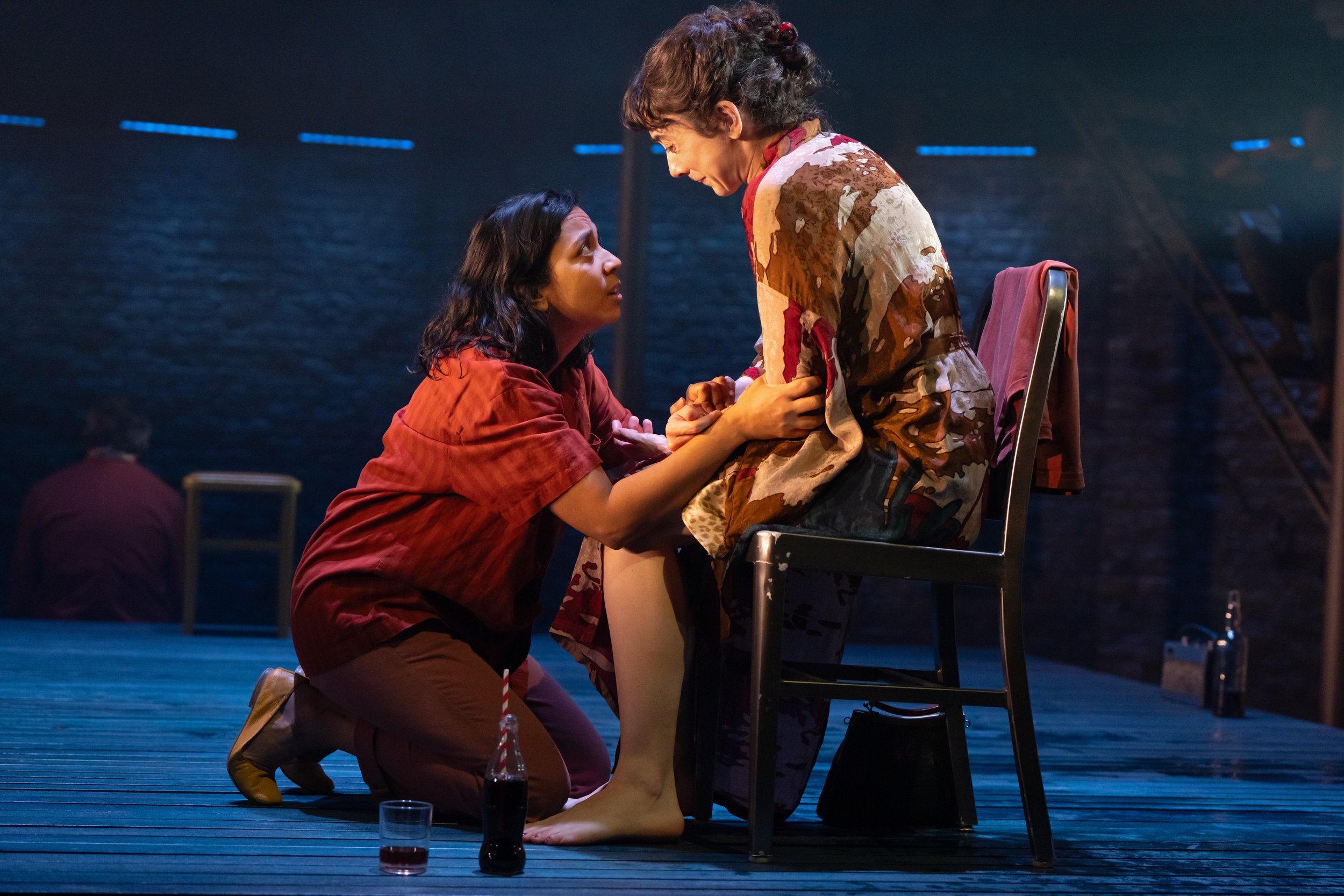
Anjana Vasan and Patsy Ferran as Stella and Blanche. Photo by Julia Cervantes.
My tragic sensibilities were well primed for Streetcar because a few days prior the topic of tragedy was forever expanded for me by Merve Emre after completing our study of Henry James’, Portrait of a Lady, another great life first, in her New York Review of Books Seminars class. Merve taught us that:
“…the tragic heroine need not be noble, only broadly representative. Her actions need not be nationally or politically consequential; indeed, a tragic figure is often destroyed by a world that he or she has no power to change. Fate and Fortune need not be the work of the gods, those divine puppeteers, but the patterns laid down by the social order.”
This resonated deeply because, no contest, James’ portrayal of Isabel Archer’s own disillusionment felt more tragic to me than any hubristic hero who meets classic criteria of social consequence. In Isabel the potential for that individual’s mental anguish becomes as terrifying as a physically violent end. Hamlet is not tragic because he is eminent and dies; he is tragic because he thinks and therefore he suffers. To wit, one particular fleeting moment in Portrait stayed with for its grim matter-of-factness. Seeking to discourage Isabel’s marriage to an eery and unaccomplished man, her aunt and benefactor Mrs. Touchett says plainly, “Do you think he’s going to make you happy? No one is happy.”
Seventy years after James penned that line, the plight of Streetcar’s persona might imply that Williams agrees with James, or is at least exploring the possibility; as with Hamlet, not one character is spared the loss of innocence if not life by the end. Instead of littered with poisoned bodies, Williams’ stage is poisoned with irreversible mistakes, bad luck, sorrow and shame. And the greatest tragedy of all belongs to Stella, who was an erotic, accepting, and more or less contented—albeit abused—wife when the play opens. We watch her fall from instinctive happiness into a stony recognition that her husband’s bad behavior is not as simple is rowdy poker. She is a crushed new mother by the end of the play, resorting to willful denial to keep living with her husband, and herself.

Anjana Vasan and Paul Mescal. Photo by Julia Cervantes.
“Now, then, let me look at you. But don’t you look at me, Stella, no, no, no, not till later, not till I’ve bathed and rested! And turn that over-light off! Turn that off! I won’t be looked at in this merciless glare!“
—Blanche, Scene 1
Blanche, on the other hand, is tragedy personified through an unlucky combination of her nature—variously called flighty, sensitive and tender throughout the play—and her hard knocks alongside the social context of the day, including its pharmaceutical/psychiatric limitations. The result is self-medication through a hard-to-watch tagteam of the alarmingly once legal sedative Bromo-Seltzer and alcohol.
Of all the play’s blows that land squarely, Blanche’s vanity is among the toughest to take, and Williams honors its seriousness. He repeatedly draws attention to her dilemma—aging—using light as the obvious trope with Blanche flitting moth-like to cover bulbs and cower in shadows, hiding her age and, symbolically, her past. Watching the thirty-year-old shrink from daylight and overhead lights as Williams brandished his device stung with truth. Forty is only the new thirty because of cosmetic intervention; if I’d never seen a dermatologist, I can approximate what those naked bulbs would reveal. Aging aesthetically is a complex challenge even when one isn’t as vulnerable as Blanche in her day.
With this in mind, the emotional peak of the play might be when she cries out:
“Physical beauty is passing. A transitory possession. But beauty of the mind and richness of the spirit and tenderness of the heart—and I have all those things—aren’t taken away, but grow! Increase with the years! How strange that I should be called a destitute woman! When I have all of these treasures locked in my heart.”
These could-be-cliché words of self-empowerment rang with deeper meaning in Blanche’s oracular state and the pain, we see all clearly, of its being too late for her. The next stage direction reads, “A choked sob comes from her.” I, too, was right on cue.

Patsy Ferran
“I can’t escape unhappiness…In marrying you, I shall be trying to. I am not bent on being miserable…I have always been intensely determined to be happy, and I have often believed I should be. I have told people that; you can ask them. But it comes over me every now and then that I can never be happy in any extraordinary way; not by turning away, by separating myself…from life. From the usual chances and dangers, from what most people know and suffer.”
—from Portrait of a Lady, Chapter LIII*